A Guide to the Right of Abode in Hong Kong
An unofficial guide explaining the complicated Hong Kong identity card (HKID) and right of abode (ROA) mumbo jumbo for overseas HK descendants (such as ABCs, BBCs and CBCs)...
>> shortcut to Discussion/Comments (powered by DISQUS)
Hello! 你好!
Welcome to the Unofficial Guide to the Right of Abode in Hong Kong. This webpage features general information and FAQs on the right of abode and right to land for the children of Hong Kong permanent residents born outside of Hong Kong.
Last updated:
Introduction
During my visit to Hong Kong in May 2008, I decided to go through the process to see what kind of residency status I can get there due to the fact that both of my parents were born in Hong Kong, I had heard a lot of conflicting info from friends and family, and I wasn't totally sure myself when I had applied. I was not born in Hong Kong; I was born in Canada after my parents had immigrated there.
This is a guide primarily directed to people who have Hong Kong parents who were born in a foreign country (i.e. not born in any part of China), who may have a connection to Hong Kong. This webpage is not meant as legal advice as I am not a lawyer or immigration consultant. It took me many weeks to understand some of the laws, and how it applied to me. But I also learned a lot in regards to how the laws regarding Chinese nationality and Hong Kong permanent residency work. Hopefully it can provide you with some insight on the right of abode in Hong Kong, a topic that is often misunderstood even by its own residents.
When doing my research, I found it extremely difficult as the Hong Kong government websites were often confusing and ambiguous, in both English and Chinese languages. My Chinese skills aren't exactly that great, but sometimes it was useful to be able to look at both versions of their websites. In Hong Kong, if there are any conflict in laws, the Chinese version takes precedent even though the government and the judiciary do often use English as the language for law. This is especially relevant because the Chinese laws, such as the nationality law, the only legally valid version is the version in Chinese, translations are just provided in English by the HKSAR government for reference.
As we all know, since July 1, 1997, Hong Kong is a Special Administrative Region in the People's Republic of China, which means Hong Kong is an inalienable part of China. But on the famous policy of "one country, two systems", Hong Kong continues to have a high degree of autonomy including in immigration matters.
This guide may be a bit verbose and boring to read, but applying for right of abode (ROA) in Hong Kong is a complicated process, it is important to understand if you are eligible for status in the first place or it would be a considerable waste of time to apply and find yourself being denied.
Summary - Born outside Hong Kong, can I get ROA and a HKID?
This topic is very long and tedious, here is a high level summary of who can have right of abode in Hong Kong by birth outside Hong Kong, if you are at least one of the following:
- You are a Chinese citizen (that is a citizen of the People's Republic of China) born to a parent who is a Chinese citizen born in Hong Kong, or to a parent that is a Chinese citizen who has lived 7 years in Hong Kong and obtained ROA before your birth. Whether you were born a Chinese citizen, depends on other factors that will be explained later in this document. Chinese citizenship can be obtained both before and after the handover in Hong Kong. In other words, even before Hong Kong was returned to China, China still applied the nationality law retroactively there, even though it theoretically cannot be enforced yet.
- You were born between January 1, 1983 and June 30, 1997 and were a British Dependent Territories Citizen associated with Hong Kong, i.e. one that was born to a parent that was a BDTC born in Hong Kong, or to a BDTC that naturalized as a British subject in Hong Kong before your birth. The BDTC parent can either be the mother or legitimate father.
- You were born before January 1, 1983 and at your birth were a Hong Kong Belonger. A Hong Kong Belonger is a British subject with a close connection to Hong Kong. If you were born before 1983 and you were a Citizen of the United Kingdom and Colonies (CUKC) or a Commonwealth citizen, you were a British subject.
Chinese citizenship was applied retroactively to most people of Chinese race before the handover. Hence, one can still be a Chinese citizen even before China resumed sovereignty of Hong Kong. Effectively, the Chinese and British nationality laws co-existed in Hong Kong before the handover and to an extent after as well.
As Hong Kong returned to Chinese sovereignty on July 1, 1997, if one was born on and after that date, it is impossible for one to obtain any British status and get ROA through this route. One can only obtain ROA by birth outside Hong Kong if one is a Chinese citizen.
Non-Chinese citizens with ROA will lose ROA if they do not meet certain residency requirements, and be downgraded to right to land (RTL), however RTL also allows that person to live, work or study in Hong Kong.
Chinese Nationality Law
Despite what people perceive, there is no such thing as "Hong Kong citizenship" since Hong Kong is not an independent country, it is part of the People's Republic of China. The Nationality Law of the People's Republic of China is one of a few national laws that apply in Hong Kong. Citizenship and nationality essentially mean the same thing in Chinese law, I may use both terms interchangeably.
Although Hong Kong was under British administration for 150 years until the return in 1997, China has always considered Hong Kong as part of its territory. Hence even before the handover, it still considered many of its residents to be Chinese citizens. One interesting application of Chinese nationality law is that it applied both before and after the handover, it was retroactive even though Hong Kong was still under British administration before 1997.
According to an interpretation of the nationality law adopted at the 19th Session of the Standing Committee of the 8th National People's Congress in 1996, "a Hong Kong resident is of Chinese descent and was born in the Chinese territories (including Hong Kong), or where a person satisfies the criteria laid down in the Nationality Law of the People's Republic of China for having Chinese nationality, he is a Chinese national."
This is an English translation, which has no legal effect as it is a Chinese law from the mainland that also applies in Hong Kong. In Chinese, the part regarding Chinese decent states "凡具有中國血統的香港居民", meaning any Hong Kong resident with Chinese race. I imagine this is how the existing Hong Kong residents born in Hong Kong before the handover in 1997 were recognized as Chinese citizens, even though they were British subjects. According to HKCFI 110/2017, it appears being of Chinese race (whether or not they hold PRC citizenship) and born in Hong Kong is considered to be a Chinese citizen at birth even after the handover.
Dual nationality is not recognized in the People's Republic of China, according to the nationality law. Ordinarily, that means that one cannot hold two passports. But a special interpretation also from the 19th Session of the Standing Committee of the 8th National People's Congress allows Hong Kong Chinese nationals to hold foreign passports, but they would still be regarded as Chinese citizens, and cannot seek foreign diplomatic assistance in China. This effectively means that Hong Kong Chinese citizens can have dual citizenship in some cases, whereas mainland Chinese citizens cannot.
HK Chinese citizens holding foreign citizenship may make a "declaration of change of nationality" to have their foreign citizenship recognized in China. But by doing so, they will no longer be a Chinese citizen, though they will become be eligible for consular protection in China. Making a change of nationality makes it no longer possible to hold a HKSAR passport, and it may also affect the right of abode status in Hong Kong depending on one's residency history in Hong Kong. (Source: HK Immigration Department)
As this guide is meant for people born overseas (who most likely have foreign citizenship), Article 5 of the PRC nationality law is of particular interest.
"Any person born abroad whose parents are both Chinese nationals or one of whose parents is a Chinese national shall have Chinese nationality. But a person whose parents are both Chinese nationals and have both settled abroad, or one of whose parents is a Chinese national and has settled abroad, and who has acquired foreign nationality at birth shall not have Chinese nationality."
The main idea is that China does not want to give Chinese citizenship to those born abroad that had foreign citizenship at birth. However, it gives an exception in the case that the parent or parents were not settled abroad.
One thing to note is that based on this law if you obtained foreign citizenship at birth and both of your parents are Chinese citizens, and only one is settled abroad at the time of your birth, you will be a also Chinese citizen at birth.
"Settled abroad" means the person is not subject to a limit of stay in another country (i.e. permanent residency in another country, or holding the citizenship of that country). This case would probably apply to the vast majority of Hong Kong descendants born in Canada, with the mass immigration before 1997. In fact, this definition of "settled abroad" was confirmed in the Court of First Instance case HCAL103/2011 which used case law based in 《中華人民共和國百法釋解案例全書》(Cai Cheng and Xiao Yeung, Interpretation of the Laws of the People’s Republic of China – Encyclopaedia of Decided Cases).
For example, in the case of Canada. If one or both of your Chinese citizen parents were holding permanent resident status (or had became Canadian citizens) at the time of your birth, then they are deemed to be settled abroad, by the Chinese authorities. And since you would get Canadian citizenship automatically at birth in Canada (except for diplomats), you would be not be a Chinese citizen as you will not meet the conditions of Article 5 of the PRC nationality law. This would be very similar to the case for people born in the United States to green card holders or U.S. citizens.
What this means is, that if you were born in Canada, and neither of your parents were Chinese citizens settled abroad (i.e. they held work or study permits, or were simply just visiting as a tourist), then you would be a Chinese citizen at birth.
British Nationality Law / CUKC / BDTC
When Hong Kong was returned back to China on July 1, 1997, it marked the end of British rule, and also meant changes to the nationality law and right of abode in Hong Kong.
Generally speaking, holding British nationality with an association with Hong Kong means you would have been a Hong Kong permanent resident (and had right of abode) before the handover on July 1, 1997. You would continue to hold ROA after the handover if you were also a Chinese citizen, or if you met certain residency requirements. Otherwise you would lose ROA and obtain the right to land (RTL), the details for this will be explained later.
Born before January 1, 1983
Before January 1, 1983, a Hong Kong Belonger would have right to land in Hong Kong - the concept right of abode did not exist yet, however it appears to have been interpreted as permanent residency or right of abode now.
A Hong Kong Belonger is a British subject with a close connection to Hong Kong. If you were born before 1983 and you were a Citizen of the United Kingdom and Colonies (CUKC) or a Commonwealth citizen, you were a British subject. (Source: Wikipedia) Before 1983, anyone born in the United Kingdom and Colonies (including Hong Kong) would have CUKC automatically at birth. However, if born abroad before 1983, the child can only be a CUKC if the father was a CUKC, and the parents must have been married. If the mother is a CUKC and the father is not a CUKC, then the child will not be a CUKC. (Source: Wikipedia)
A Hong Kong Belonger was specifically defined as such:
- (i) a British subject who was born in Hong Kong;
- (ii) a British subject by naturalization in Hong Kong;
- (iii) a British subject by registration in Hong Kong under section 7(2) of the British Nationality Act 1948;
- (iv) a British subject married or who had been married to, or was a child of, a person mentioned in sub-paragraph (i), (ii) or (iii);”.
Because of how the law was defined, even if born abroad, it is possible to be a Hong Kong Belonger without being CUKC as long as you are a Commonwealth citizen (i.e. having citizenship in a Commonwealth country such as Canada, Australia, New Zealand), until 1983 Commonwealth citizens were considered British subjects. I believe this would only apply in the case where only the mother is a Hong Kong Belonger. (Source: HKU Law Society)
Born between January 1, 1983 - June 30, 1997
As of January 1, 1983, all CUKCs became British Dependent Territories Citizens (BDTC). While the status is generally the same concept, there are some differences in how one can acquire BDTC.
On and after January 1, 1983, if born in Hong Kong, one would only be a BDTC if at the time of birth, at least one of the parents were a BDTC or otherwise "settled" in Hong Kong. (Before 1983, anyone born in Hong Kong would be a CUKC, which they automatically became BDTC in 1983) As of July 1, 1997, it was no longer possible to become a BDTC by birth with connection to Hong Kong. In other words, anyone that is born after the handover in 1997 can no longer have this citizenship.
It is also possible to obtain BDTC status by descent for one generation, if born outside Hong Kong to a BDTC parent also did not inherit it themselves through birth outside Hong Kong. (Source: Wikipedia - BDTC is now known as BOTC) If only the mother was a BDTC by birth in Hong Kong or by naturalization, then the child will be a BDTC automatically. But if only the father was a BDTC by birth in Hong Kong or by naturalization (and not the mother), the child will only be a BDTC if the parents are married.
BDTC status ceased to exist as of the handover on July 1, 1997, and all BDTC passports expired as of July 1, 1997.
However, it was possible for BDTCs to register as a British National (Overseas), which allows one to hold a BN(O) passport. The BN(O) does not provide the holder right of abode in the United Kingdom or other rights in the European Union. Registration as a BN(O) is no longer possible after the handover. Those who have registered for BN(O) status can continue to hold a BN(O) passport for the rest of their life.
One important thing to note is that, all BDTCs had the right of abode in Hong Kong before July 1, 1997. (Source: Immigration Ordinance Schedule 1, 1997)
Born on or after July 1, 1997
It is no longer possible to obtain any British nationality associated with Hong Kong.
Hong Kong Certificate of Identity
The Hong Kong Certificate of Identity was a travel document issued by the colonial British government for Hong Kong permanent residents that were not British. (Source: Wikipedia)
Most holders of the CI were immigrants from the mainland that were not naturalized as British subjects. If they were naturalized they would become eligible to hold a BDTC passport.
Anyone of Chinese race ordinarily resident in Hong Kong for 7 continuous years will become a permanent resident (and have the right of abode). (Source: Immigration Ordinance Schedule 1, 1997)
Children of HK CI holders born abroad will most likely not be eligible for right of abode in Hong Kong unless the child is a Chinese citizen at birth and meet the criteria in the Basic Law Article 24(3).

Right of Abode
Hong Kong permanent residents (香港永久性居民) possess the "right of abode" (居留權) meaning they are allowed to live in Hong Kong without subject to a condition of stay, and the right to not be deported or removed. Essentially, this is a de facto citizenship for Hong Kong, but the interesting thing is that both Chinese and non-Chinese citizens can hold this status. However, the rules for Chinese and non-Chinese citizens to obtain and retain ROA are different.
Explaining the ROA in Hong Kong is complex, but I'll just go through it briefly. As of the handover on July 1, 1997, the following are Hong Kong permanent residents as defined in the Hong Kong Basic Law Article 24:
- (1) Chinese citizens born in Hong Kong before or after the establishment of the Hong Kong Special Administrative Region;
- (2) Chinese citizens who have ordinarily resided in Hong Kong for a continuous period of not less than seven years before or after the establishment of the Hong Kong Special Administrative Region;
- (3) Persons of Chinese nationality born outside Hong Kong of those residents listed in categories (1) and (2);
- (4) Persons not of Chinese nationality who have entered Hong Kong with valid travel documents, have ordinarily resided in Hong Kong for a continuous period of not less than seven years and have taken Hong Kong as their place of permanent residence before or after the establishment of the Hong Kong Special Administrative Region;
- (5) Persons under 21 years of age born in Hong Kong of those residents listed in category (4) before or after the establishment of the Hong Kong Special Administrative Region; and
- (6) Persons other than those residents listed in categories (1) to (5), who, before the establishment of the Hong Kong Special Administrative Region, had the right of abode in Hong Kong only.
If you are a Chinese citizen born outside Hong Kong to a Chinese citizen born in Hong Kong, or if you are a Chinese citizen born outside Hong Kong to a Chinese citizen who lived 7 years in Hong Kong, then you will have right of abode in Hong Kong by birth. Whether one is a Chinese citizen depends on the PRC nationality law.
But, if you are a non-Chinese citizen born outside Hong Kong, you will not be eligible for right of abode in Hong Kong. However, all non-Chinese citizens can obtain ROA by 7 years ordinary residence in Hong Kong as a resident and declaring Hong Kong as the place of permanent residence; however they will require a visa to stay in Hong Kong.
In addition to these 6 categories, there are also "transitional provisions" for the right of abode to accommodate existing permanent residents. Essentially anyone that was a permanent resident of Hong Kong before July 1, 1997 would continue to be PR after the handover. (Source: HK Immigration Department)
As mentioned earlier, all BDTCs had the right of abode in Hong Kong before July 1, 1997. Therefore, if you are a non-Chinese citizen born outside Hong Kong before July 1, 1997, and one of your parents was a BDTC (by birth in Hong Kong, or naturalization) before you were born, then you would also have been a BDTC, and as a result you would be eligible for right of abode in Hong Kong before the handover, and continue to have it at the time of the handover. (Source: Hong Kong Economic and Trade Office via archive.org)
Loss of Right of Abode / Obtaining Right to Land for Non-Chinese Citizens
With the change in immigration law after the handover, non-Chinese citizens will lose the right of abode in Hong Kong if they do not meet the requirements in order to retain ROA. This part is a little complex, and I'll try to explain it in the simplest way possible (since it's largely irrelevant as you can't go back in time to settle in Hong Kong). In general, non-Chinese citizens that are absent from Hong Kong for a period of 36 months will lose the right of abode.
In addition, non-Chinese citizens that had ROA by virtue of being a BDTC, must have either been settled in Hong Kong immediately before the handover, or returned to settle within 18 months of the handover (so by December 31, 1998), and subsequently not being absent from Hong Kong by 36 months thereafter.
But upon losing the right of abode, he or she automatically obtains the "right to land" (入境權), which allows he/she to live, work or study in Hong Kong without restriction. Persons with RTL status can be deported for serious crimes, which is not the case for those with ROA. Also, only those with ROA have the right to vote, so those holding RTL are not eligible to vote. (Source: Immigration Ordinance Section 2AAA)
The right of abode can be then re-obtained by being ordinarily resident in Hong Kong for 7 years, and making an application for it.
Chinese citizens do not lose right of abode regardless of the length of absence from Hong Kong.
Hong Kong Identity Card
There are two types of identity cards, the "permanent identity card" issued to residents holding the ROA, and a regular identity card that is issued to those who don't have ROA. Anyone residing in Hong Kong for more than 180 days is required by law to register for an identity card. If you aren't going to be living in Hong Kong, it is technically not necessary to register for one, though it can have some real advantages such as faster border clearance.
Those that have right to land will be issued a non-permanent identity card. Though in essence, a RTL ID card is permanent.
The HKID card has "codes", depending on your residency status. For example, A is right of abode, R is right to land.
This Wikipedia page can explain the other status codes.
Hong Kong Re-entry Permit, * (one star) and *** (three stars)
A Hong Kong Re-entry Permit (回港證) is a document used to re-enter Hong Kong from either mainland China and Macau. This document can be held by Chinese citizens who have ROA or unconditional stay in Hong Kong, or non-Chinese citizens who have unconditional stay in Hong Kong and cannot obtain any other travel document. (Source: Wikipedia)
* and *** on Hong Kong identity cards represent the right for a Hong Kong Re-entry Permit. * is for those between ages 11 and 17, and *** is for those that are 18 and over.
In practice, as Hong Kong identity cards with * and *** can be used to re-enter Hong Kong, therefore it is an uncommon document to have. However, children under 11 will need a re-entry permit or a passport in order to return to Hong Kong as their identity cards cannot be used for immigration clearance.
As the vast majority of HKID holders with * or *** are Chinese citizens, it is somewhat of a de facto representation of Chinese citizenship on HKID cards. However, from what I have researched on the Internet, there appear to be some foreign born HK residents with * or *** that have had the status revoked after the Hong Kong immigration department discovered that they were not holding Chinese citizenship - this is likely due to errors in the original verification for status in Hong Kong. My theory is that the rules on how to apply the law were murky prior to the handover, and in the immediate years after it.
HKSAR Passport
Chinese citizens with the right of abode in Hong Kong are eligible for a Hong Kong Special Administrative Region passport for travel to foreign countries. The HKSAR passport is a People's Republic of China passport, even though it is issued by the Hong Kong authorities. It has visa-free access to over 140 countries and territories, making it one of the world's most convenient passports.
Home Return Permit
A Home Return Permit (通行證 / 回鄉證) is a document issued to Hong Kong residents that are also Chinese citizens for travel to the mainland. This document is issued by mainland authorities, from my understanding it has basically become a de facto identity document to use while in the mainland. HKSAR passports are not acceptable for travel to the mainland, and technically neither are foreign passports (if one is a Chinese citizen). That being said, it isn't exactly uncommon for visas to be issued in foreign passports (of HK Chinese citizens) for visits to China.
My case
As mentioned earlier, both of my parents were born in Hong Kong. They are Chinese citizens at birth (despite the fact they have also become Canadian citizens) with the right of abode in Hong Kong, and are eligible to hold HKSAR passports. My parents did not make a declaration of change of nationality to the Hong Kong Immigration Department, so in China they will continue to be Chinese citizens. Since they were born in Hong Kong before 1983, they were also CUKC at birth and later became BDTC (in 1983), they also would have been eligible for the BN(O) passport, but had never applied for it, and now it is impossible.
My parents immigrated to Canada in the 1980s, and I was born in Canada in 1985. I was automatically a Canadian citizen at birth because Canada operates under the "jus soli" rule, where anyone born in Canada is a Canadian citizen regardless of the parents' immigration status (except children of foreign diplomats).
Based on what I described above, under the Chinese nationality law, despite the fact that both of my parents are Chinese citizens, at the time of my birth they were settled abroad in Canada (had PR status), and I obtained Canadian citizenship at birth, so therefore I am not a Chinese citizen. Based on the immigration laws adopted at the handover, I would not have been eligible for ROA in Hong Kong.
But according to the "transitional provisions", even though I was a non-Chinese citizen, I had the right of abode in Hong Kong before July 1, 1997 because I was a British Dependent Territories Citizen by descent, since my parents were BDTC by birth in Hong Kong.
I had visited Hong Kong twice before 1999 using a Canadian passport. If I was considered "settled", I would meet one of the provisions and I would have still been holding ROA at that point (despite not formally holding that status). From what I have read on the HK Immigration Department website, a settled purpose can be of any length or duration, so perhaps I could have been considered "settled" even if it was just for a "visit". I had visited again in 2001, and had not returned until 2008. As non-Chinese citizen that has been away from Hong Kong for a period exceeding 36 months since July 1, 1997, I have lost my ROA, and obtained the right to land (RTL).
However, neither me nor my parents really understood this until it was far too late, and imagine I presumably would have lost ROA around 2004. If I had visited Hong Kong a few more times between 2001 and 2008 to fill the gaps, then I could have retained ROA by not being absent for more than 36 months.
One thing to note is that I did not apply for VEPIC until 2008, it appears they will retroactively evaluate your previous residency and visits in Hong Kong, if you are a non-Chinese citizen to see if you meet the requirements to continue to hold the right of abode.
Interestingly, I could have continued to have British nationality by holding a British National (Overseas) passport if my parents had registered for me me before the handover. But as it is no longer to register as BN(O) after the handover, I am no longer have any British nationality. My parents didn't register themselves either, so they likewise lost their British nationality as of the handover, so right now they are dual Canadian and Chinese citizens. It's not much of a loss though, as the BN(O) passport does not provide the right of abode in the United Kingdom, and the Canadian passport has visa free access to most of the countries the BN(O) has.
To summarize, my current status is that I am only a Canadian citizen that happens to have the right to land in Hong Kong. I am not eligible to obtain a HKSAR passport, nor the Home Return Permit to visit mainland China. I do however, have the right to live, work and study in Hong Kong without restriction. I did register for a Hong Kong Identity Card, although it is not technically necessary as I don't currently live in Hong Kong.
How to Apply
If after going through this guide and the relevant laws, you believe that you are eligible for right of abode/right to land in Hong Kong, you apply for the status at the Hong Kong Immigration Department. If you were born outside Hong Kong to a Hong Kong parent, effectively you can only get ROA in Hong Kong if you were a CUKC, BDTC and/or a Chinese citizen.
You cannot apply for a HKID card directly at first. You will need to apply using the ROP145 form ("Application for Verification of Eligibility for Permanent Identity Card"). Details to apply can be found at http://www.gov.hk/en/residents/immigration/idcard/verifypic.htm. It is possible to now submit applications for VEPIC online.
You must be physically in Hong Kong in order to submit a ROP145 application (even for online applications); you can do this as a "visitor" using your passport to enter the region. Applications while you are outside of Hong Kong will be refused. According to an immigration officer I spoke to, you can even "apply the day you're there, and leave the Hong Kong next day" and have the formalities can be completed by a representative. It will likely at least 6 to 8 weeks to complete the process. You will need to apply with a Hong Kong mailing address to deal with correspondence and additional requests for information.
Submitting photocopies of the following documents should be sufficient to prove BDTC and/or Chinese citizen status, however what exactly is needed may vary:
- Your birth certificate (showing parents' names and personal details)
- Your passport
- Parents' Hong Kong birth certificates
- Parents' Hong Kong identity cards
- Parents' marriage certificate (if applicable)
- Parents' BDTC passports showing immigration status abroad (i.e. landing papers, immigration visas)
- Parents' naturalization certificates (if they naturalized as foreign citizens)
More documents may be needed, but these were the ones that I was requested for by the Immigration Department. Once copies are submitted, they will do some verification, and may ask you to fill out additional forms. If you are approved for ROA or RTL, you will be asked to bring in original copies of some of the documents for verification (some people refer to this as an "interview" - though strictly speaking it is not). They asked me to bring my birth certificate, passport, parents' birth certificates and identity cards, and their marriage certificate. A representative in Hong Kong can also bring in the documents for verification, if you include a letter authorizing them to do so.
Once the original documents are verified, you will be granted the appropriate status in a letter, and you can then register for a Hong Kong Identity Card, just like any other resident in Hong Kong.
This is a copy of a letter from Hong Kong Immigration Department telling me that I will have RTL pending document verification (click to enlarge). There is no direct way to apply for the RTL status (if that is what you think you will get), you will be applying to verify if you had ROA at some point, they will explain why you don't currently have ROA, but that you now have RTL.
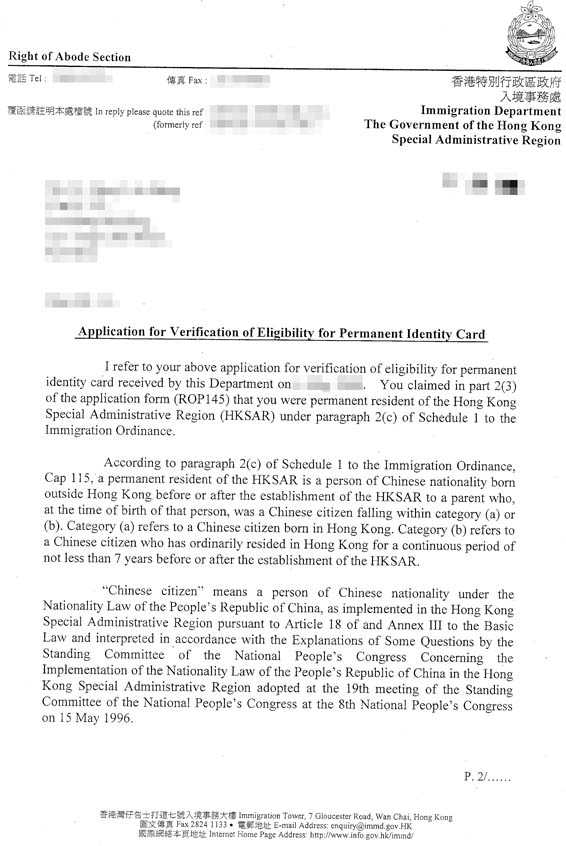
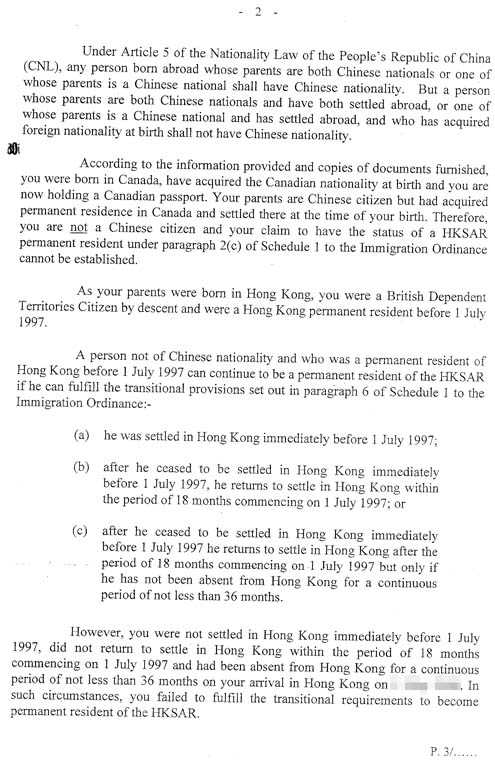

This letter is the one that was issued after original documents were verified. I brought this letter along with my passport to a Registration of Persons office for registration of a Hong Kong identity card.
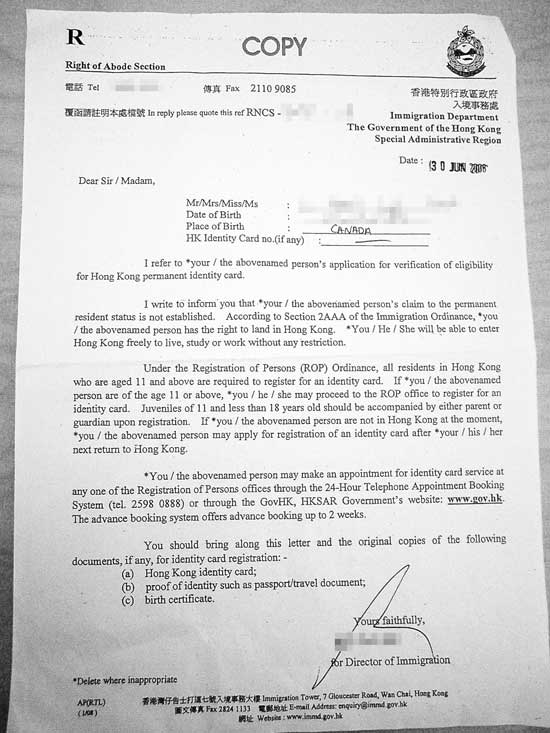
One more thing to note, if you have completed the VEPIC process, but don't have a Hong Kong ID card yet, it may be more of a hassle when crossing the border as it appears to raise flags with immigration officers. I would recommend carrying your VEPIC documentation for convenience.
Travelling to Hong Kong? Planning a trip?
If you are planning to travel to Hong Kong to apply for the VEPIC, I would recommend buying a round trip flight to the city - even if you think your application will be successful and want to stay. Although the Hong Kong immigration does not usually check for return tickets, it is better to do this to avoid issues. It also prevents you from accused of planning to overstay before your residency status is confirmed.
Besides, you don't necessarily know if the place will be right for you, so it's a good idea to make a visit first!
Do I need a visa to visit Hong Kong? Most nationalities do not require a visa to visit Hong Kong for tourist purposes. (Especially from countries that many Hong Kong emigrants moved to) However, more information can be found on the Hong Kong immigration website. Please verify if you require a visa before planning your trip.
FAQs (frequently asked questions)
Q: Do you work for the HKSAR government?
A: No.
Q: I'm of Chinese race, am I a Chinese citizen?
A: It depends if you meet the requirements of the PRC Nationality Law. Race and citizenship are not synonymous.
Q: I can't speak Chinese, can I still apply?
A: Yes, the forms are available in both English and Chinese, the official languages of Hong Kong. The Immigration Department of Hong Kong has English speaking officers. Of course your Chinese name has to be written in Chinese, but you don't have to provide one if you don't want to.
Q: I'm not of Chinese race, can I still get ROA?
A: Most likely you would not be a Chinese citizen. But, as long as you meet the requirements by inheriting BDTC status and/or meet the requirements under the Basic Law, then you can also make a claim.
Q: My parents have HKID cards, can I get one too?
A: This is by far one of the most common questions I get. It really depends, just because your parents have status in HK does not necessarily mean that you do. Hong Kong identity cards are for identity, it does not give any rights. Put simply it's just a document that states your rights. This website should explain whether you hold the right of abode or right to land. And if you do, then you can get a HK ID card.
Q: Only one of my parents is from Hong Kong and I was born outside Hong Kong, will I still get ROA or RTL?
A: It depends. For claims of Chinese nationality (both before or after the handover), if one meets the requirements, as long as one of the parents is a Chinese citizen, that is sufficient. Based on the cases I have read, it does not appear that "legitimacy" of a child matters for Chinese nationality law.
For CUKC/BDTC it is more complicated. If you were born outside Hong Kong before 1983, BDTC did not exist yet, so you have to look at how one gets CUKC - and it can be only be obtained through the father, and you must be a legitimate child (married to the mother). If only your mother was CUKC, and father was not, then you will not be CUKC. In 1983, all CUKC automatically became BDTC. What this basically means is that those with a CUKC mother and non-CUKC father born before 1983 will be not CUKC, and therefore would not be able to automatically be BDTC in 1983 because they never were a CUKC. But the same parents with another child born in or after 1983 (but before 1997), that child will be BDTC because the mother was a BDTC, and the mother can pass it off by descent for one generation. Also, if the BDTC claim is through the father, the child must be a legitimate child.
All BDTCs had the ROA before July 1, 1997, and continued to have it after the handover as long as they met the residency requirements.
Q: I have *** on my Hong Kong identity card, does this mean I can get a Home Return Permit for trips to China?
A: Typically that would be yes, but it seems like a lot of foreign born children of Hong Kongers have *** issued to them in error. *** represents the right to a Hong Kong Re-entry permit for someone 18 or older, but only Chinese citizens or stateless persons with right of abode or on unconditional stay are eligible.
Q: My Hong Kong parent was born in mainland China, I was born in another country, can I get ROA in Hong Kong?
A: This is a complicated question. If you are a Chinese citizen according to the PRC Nationality Law, and born after your parent obtained right of abode in Hong Kong, then yes, you would also have ROA in Hong Kong. If you are not a Chinese citizen, then your parent must have naturalized as a British subject before your birth, and you had to be born before July 1, 1997 in order for you to get BDTC and ROA status in Hong Kong.
Q: My parents don't have their birth certificate and valid Hong Kong ID cards, can I still apply?
A: If they were born in Hong Kong, they can re-apply for a birth certificate. As for the HKID card, they can obtain one by visiting Hong Kong, or if they are a Chinese citizen by applying at a Chinese foreign mission for a HKSAR passport. Applying for a HKSAR passport at a Chinese foreign mission also provides the applicant with a HKID card.
Q: What does "settled abroad" mean in terms of Chinese nationality?
A: It means holding foreign permanent residence, this can be either permanent residency (green card in the USA, permanent resident status in Canada) or holding another citizenship.
Q: I have RTL, will my children born outside Hong Kong have any status in Hong Kong?
A: Your children will not be entitled to any status in Hong Kong at birth no matter where they were born. However, you can sponsor them to live with you in Hong Kong, and after 7 years residence they can apply for ROA in their own right.
Q: I have RTL, if my children are born in Hong Kong, will they have any status?
A: If the child is a Chinese citizen (i.e. at least one of the parents is a Chinese citizen) then he/she will have automatic right of abode in Hong Kong if born there. If the child is a non-Chinese citizen (i.e. both parents are not Chinese citizens), the child will have ROA if one of the parents has ROA in Hong Kong at time of birth. If neither of the non-Chinese parents have ROA at the time of birth of the child, the child will only get ROA automatically if before the age of 21 one of the parents obtains ROA. (If they not have ROA at birth, the child will need to be sponsored to stay in Hong Kong) However, ROA obtained by birth in Hong Kong by non-Chinese citizens will be lost automatically age 21 and downgraded to right to land, unless the child is eligible in his/her own right by 7 years residence, and formally applying for ROA.
Q: I have RTL, how can I get right of abode back?
A: You simply have to be ordinarily resident in Hong Kong for a continuous period of 7 years, then apply for VEPIC again and prove that Hong Kong is your place of permanent residence. If approved, you will then obtain ROA and can register for a permanent identity card.
Questions?
If you have questions, feel free to e-mail me at hkroaguide@sm128c.com and I'll see if I can help. Please keep in mind that this is not legal advice and all the information I provide is my own interpretation based on Hong Kong immigration law and my personal experience.
About Me
I'm just a regular CBC that spent his entire life in Canada. I am a fluent Cantonese speaker, I did very poorly at Chinese classes in elementary school, but later on with the help of TVB dramas and Cantopop music, my Chinese skills improved significantly. I've always had an interest in Hong Kong, it is a unique place like no other. I can read most words in newspapers and books, but my writing skills are mediocre at best, though every now and then I do some practice to improve my writing.
I think I'm probably stuck in the middle of the Canadian and Hong Kong cultures. I'm a proud Canadian, but the other side of me loves to follow what goes on in Hong Kong, such as being a fan of my favourite pop singer Joey Yung 容祖兒! Growing up, I used to think I have to choose between the two cultures, but I have grown to accept that being some of both is kind of unique and fun at the same time.
I have had the opportunity to meet some of you in person and become friends with you. I didn't expect much from this, just some guide with a summary, and now it has become a place that is frequently cited on the Internet for this topic, I am very honoured and humbled to have such an audience and garner so much respect. Hopefully this website will help you out if you are considering applying for ROA/RTL in Hong Kong.
At the end for me, it was cool to get my very own HKID card. 
Interesting Links
- Hong Kong GeoExpat Immigration and Visas Forum
- Immigration, Assimilation, Ethnicity and All That Jazz
- the UGLY Chinese Canadian
- British-born Chinese Blog


